Zum Inhalt springen

Viel Lärm um nichts Woher wissen wir von Dunkler Energie und Dunkler Materie?

17.04.2023 19:00 Uhr

Im Rahmen der Ausstellung Wie alles begann im Museum der Arbeit
  • Vortrag
  • für Erwachsene
  • Kosten: 5 €
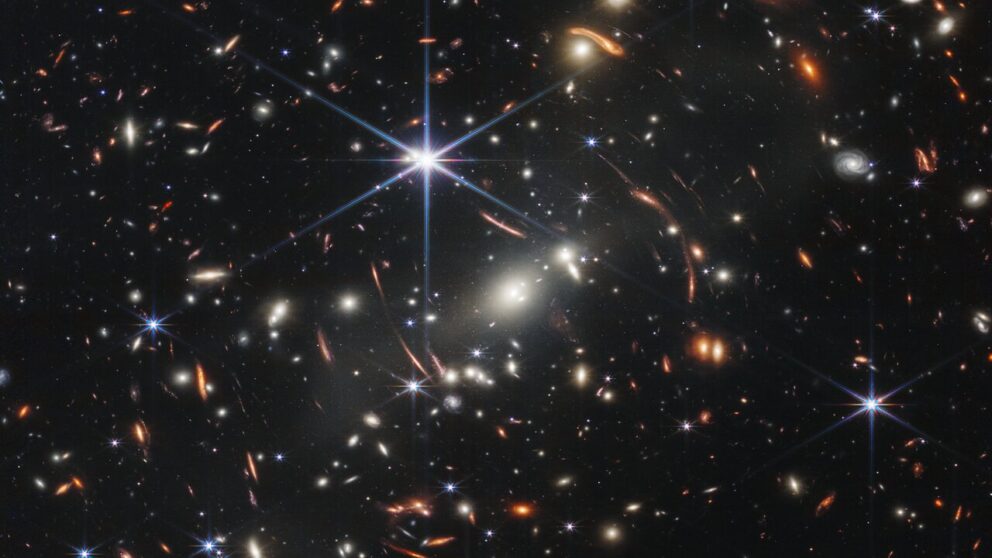
Galaxien Cluser. Aufgenommen mit dem James Webb Teleskop. Bild: ESA
Thousands of galaxies flood this near-infrared image of galaxy cluster SMACS 0723. High-resolution imaging from the NASA/ESA/CSA James Webb Space Telescope combined with a natural effect known as gravitational lensing made this finely detailed image possible. First, focus on the galaxies responsible for the lensing: the bright white elliptical galaxy at the centre of the image and smaller white galaxies throughout the image. Bound together by gravity in a galaxy cluster, they are bending the light from galaxies that appear in the vast distances behind them. The combined mass of the galaxies and dark matter act as a cosmic telescope, creating magnified, contorted, and sometimes mirrored images of individual galaxies. Clear examples of mirroring are found in the prominent orange arcs to the left and right of the brightest cluster galaxy. These are lensed galaxies – each individual galaxy is shown twice in one arc. Webb’s image has fully revealed their bright cores, which are filled with stars, along with orange star clusters along their edges. Not all galaxies in this field are mirrored – some are stretched. Others appear scattered by interactions with other galaxies, leaving trails of stars behind them. Webb has refined the level of detail we can observe throughout this field. Very diffuse galaxies appear like collections of loosely bound dandelion seeds aloft in a breeze. Individual “pods” of star formation practically bloom within some of the most distant galaxies – the clearest, most detailed views of star clusters in the early universe so far. One galaxy speckled with star clusters appears near the bottom end of the bright central star’s vertical diffraction spike – just to the right of a long orange arc. The long, thin ladybug-like galaxy is flecked with pockets of star formation. Draw a line between its “wings” to roughly match up its star clusters, mirrored top to bottom. Because this galaxy is so magnified and its individual star clusters

Mit Marc Wenskat, Beschleunigerphysiker

Mit der Ausstellung “Wie alles begann” lädt das Museum der Arbeit gemeinsam mit den Hamburger Wissenschaftseinrichtungen Universität Hamburg / Exzellenzcluster Quantum Universe und dem Deutschen Elektronen-Synchrotron DESY zu einer ganz besonderen Spurensuche ein, die über 13 Milliarden Jahre zurück in die Vergangenheit führt – zum Ursprung unseres Universums. Im Mittelpunkt der multimedialen Ausstellung, in der die neuesten wissenschaftlichen Erkenntnisse aus der Teilchenphysik, der Astrophysik und der Kosmologie für ein breites Publikum anschaulich gemacht werden, stehen die Fragen, die uns Menschen seit Jahrhunderten beschäftigen: Woraus besteht unser Universum? Hat das Universum einen Anfang und ein Ende? Wie viele Dimensionen hat das Universum? Wo kommen wir her, wo gehen wir hin?

Die Veranstaltung findet in folgenden Sprachen statt

  • Deutsch

Treffpunkt

Museum der Arbeit
Wiesendamm 3
22305 Hamburg

Telefon +49 40 428 133 0
E-Mail info@mda.shmh.de

S-Bahn 1 Barmbek
U-Bahn 3 Barmbek